

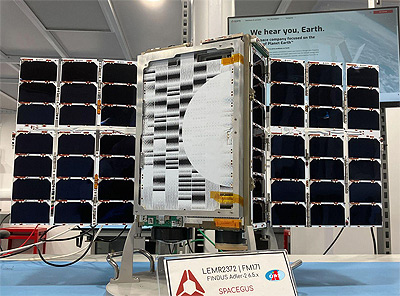
ADLER-2 Scientific research satellite is a second-generation orbital space debris detector, which is the successor to the successfully launched ADLER-1 satellite. The cubesat 6U satellite is equipped with three instruments. ADLER-2 will help improve the efficiency of space debris detection. It also carries a payload for remote sensing, allowing the study of clouds and aerosols in the Earth’s atmosphere.
| Name of Satellite | ADLER-2 |
| Purpose | Earth Science |
| Contractor | Spire Global |
| Country of Contractor | USA |
| Launch Mass (kg.) | 12 |
| Class of Orbit | LEO |
| Perigee (km) | 497 |
| Date of Launch | 15.04.2023 |
| Launch Site | Vandenberg AFB |
| Launch Vehicle | Falcon 9 |
| COSPAR Number | 2023-054K |
| NORAD Number | 56187 |
Features:
Increased detection rate: ADLER-2 is expected to increase the detection rate of space debris by 80% through the use of a space debris detection radar with an increased antenna and detection range.
Increasing the number of observations: The satellite will double the number of recorded observations of space debris.
Remote sensing payload: ADLER-2 allows you to study clouds and aerosols in the Earth’s atmosphere.
Continuation of the mission: The expected service life of the satellite in orbit is at least 1 year, after which it will burn up in the upper atmosphere.


